

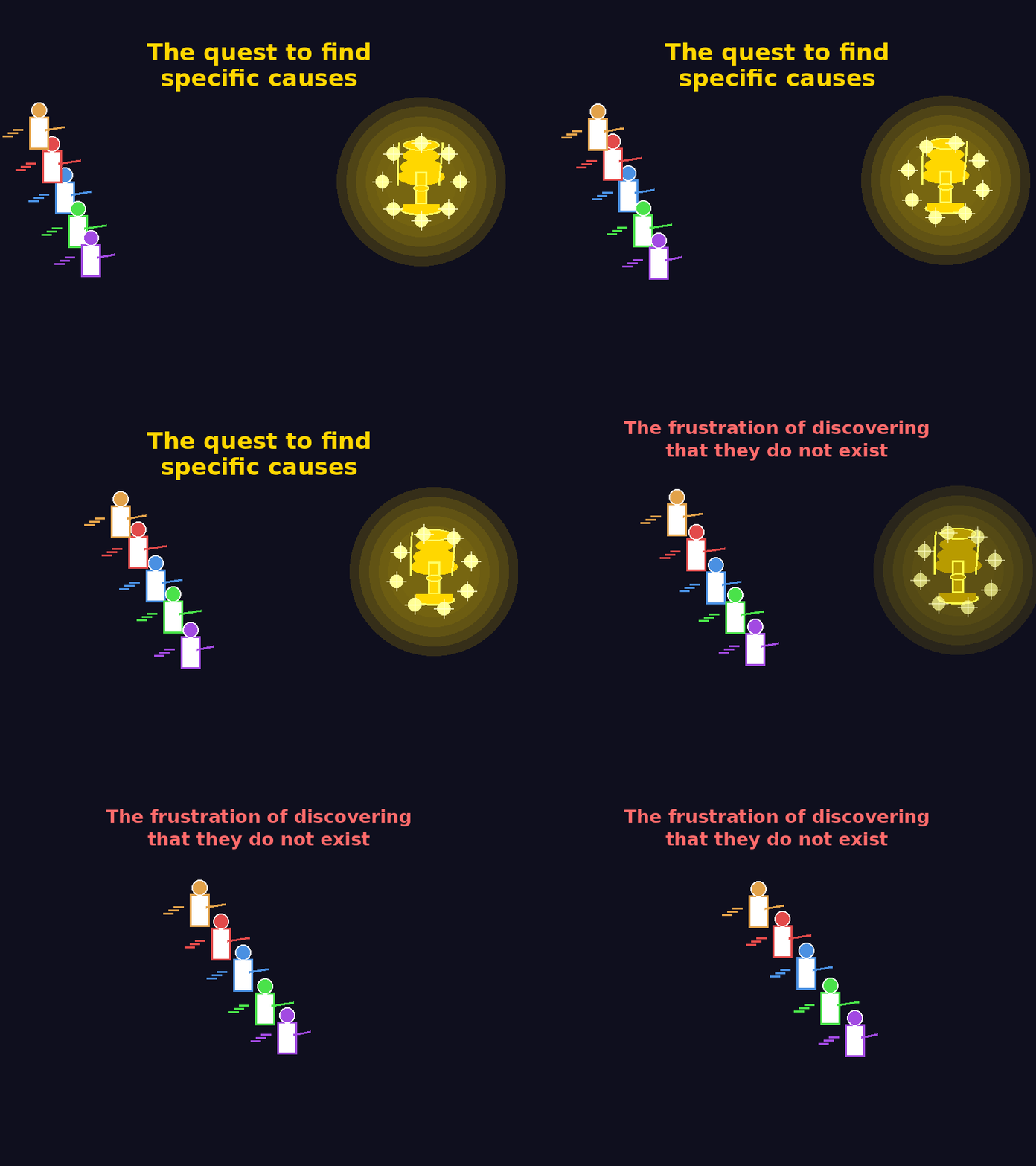
Research on mental disorders has been guided by hopes of finding specific causes that define specific disorders. That strategy worked for the rest of medicine, so it was enthusiastically adopted by psychiatry. The descriptions of mental disorders in the 1980 DSM-III were viewed as placeholders until research could discover the specific causes that would define specific disorders. Four decades of intensive research later, it is increasingly clear that psychiatry’s Holy Grail does not exist.
Hopes of finding specific genes that cause specific disorders motivated studies that found thousands of relevant variants, but they each have only tiny effects and most influence many disorders. Hopes that specific disorders resulted from excesses or deficits of specific neurotransmitters or receptors were well worth pursuing, but they too have not been fulfilled. Hopes of finding abnormalities at specific brain loci have spurred development of incredibly sophisticated methods that have revealed unimagined details about brain structure and function, but no specific brain abnormalities that cause specific disorders. It is time to accept the evidence: what we have been searching for does not exist in anything like the simple form we hoped for.
The disappointment is crushing. Mental disorders are a plague on our species, solutions are needed, and searching for specific causes is undeniably worthwhile, but it is time to respect the data. Most mental disorders don’t have specific causes. They are, like most other medical disorders, failure modes in functional systems that can have multiple causes. Anemia, rashes, and chronic cough can have many causes, but usually a specific cause can be found in a specific individual. Congestive heart failure and epilepsy are, in contrast, failure modes in functional systems that often result from multiple interacting causes. Like many other medical disorders, mental disorders are syndromes whose consistency comes not from specific causes but instead from failures in adaptive systems that can have many causes.
This evolutionary approach is not an alternative to looking for factors that explain why some individuals get a disorder, it is an additional perspective that addresses a different question: why did natural selection leave the system vulnerable to this kind of failure? There are several possible answers. Some apparent disorders are actually adaptive responses; examples include vomiting, fever, anxiety, and depression. Such responses seem pathological because they are aversive, but they can go too far to cause serious conditions such as dehydration, seizures, and anxiety and mood disorders. Other disorders, such as obesity and myopia, are products of bodies mismatched with environments far different from those humans evolved in. Natural selection pushes some traits to a performance peak near a cliff edge, so that inevitable variation leaves some individuals off the edge and vulnerable to disease. Autoimmune disorders are a good example, but the extreme ambition associated with some mood and psychotic disorders may also be relevant. Many problems result when a wrenching transition to a new niche creates strong selection that improves adaptation overall at the cost of disrupting existing systems. Shifting to a bipedal stance resulted in hernias, knee and back pain and varicose veins that persist after two million years of subsequent evolution. The shift to the social/cultural/language niche also created strong selection with net benefits but also costs, perhaps including vulnerability to the kind of system failure we call schizophrenia, a hypothesis supported by data showing that newer alleles that influence schizophrenia tend to reduce the risk. Control systems in general are vulnerable to failure, especially in modern environments, as sadly illustrated by the prevalence of eating and substance use disorders.
I will return in future essays to strategies for analyzing mental disorders as products of adaptive systems that natural selection has left vulnerable to failure, but today’s conclusion is simply that the search for specific causes the define specific mental disorders was a good idea that has not panned out. It now needs to be augmented by an evolutionary medical analysis of disorders as failure modes in adaptive systems. In the meanwhile, an extensive technical treatment of these issues is available in an article in World Psychiatry, and the challenges of creating a genuinely medical foundation for psychiatric nosology are covered in an article with the great and wonderful psychiatrist/scientist/philosopher/friend Dan Stein, who tragically passed away last week.
This framework hasn't just failed it has caused and is causing a massive amount of harm. It is currently labelling and drugging tens of millions of human beings including children with erroneous damaging self limiting so called disorders and the drugs are horrific. Yes for some a brief chemical experiment might numb or sedate but long term it's a disaster. If you are unlucky enough to be under a mental ill health team over a decade its abusive. Wild experiments with poly pharmacy and likely given multiple labels. The result, chronic illness, limbo and physically ill and dead 15 to 20 years earlier than the average person not exposed to this illness making profit seeking power obfuscation status quo maintaining machine.
Thank you for sharing this and I’m sorry for your loss