

From Nessays.com PDFs at RandolphNesse.com
Abstract
The difficulty of explaining depression is a product of how questions are framed and the nature of responses shaped by natural selection. What causes depression? is the appropriate focus of decades of research but no specific answer of the kind we expected has been found. Why can’t we find the cause? has the dismaying answer that what we have been looking for very likely does not exist. What gave rise to false expectations? calls attention to psychiatry’s medical model that looks for specific brain abnormalities without the context of normal function that guides research in the rest of medicine. What is the function of depression? blurs the distinction between normal low mood and depression and encourages viewing disorders as adaptations. What is the function of low mood? is a better question, but controversy swirls around its many possible answers. What situations shaped the capacity for low mood? focuses needed attention on the origins of low mood and its benefits in situations where effort will likely be wasted or harmful. However, that global function does little to explain hopelessness and guilt. The adaptive challenges of different situations, especially social situations in which the influence of new information on mood depends on an individual’s appraisal of the implications for attaining idiosyncratic personal goals, shape overlapping low mood states that can only barely be distinguished as parts of the cloud of responses we call low mood and depression. The messiness of this reality frustrates scientific attempts to describe simple causal influences between objectively defined, quantitatively measurable variables, but recognizing and accepting it is the first of ten tasks whose completion would create the scientific understanding of normal mood that is needed to understand mood disorders.
Questions cause problems and offer solutions
The difficulty finding explanations for depression arises from the questions we ask. A review of five questions exposes the need to ask about the origins, functions, and regulation of normal mood. The answers to those questions reveal a ragged cloud of overlapping low mood states with multiple functions that increase fitness in a variety of disparate situations at the cost of great misery.
What causes depression? is the question addressed by decades of research by thousands of scientists supported by billions of dollars. Google Scholar finds over 30,000 articles with depression in the title in 2025, up from almost 10,000 in 2005. Judged by the number of publications and the many causes found, the effort has been a grand success. We now know that the risk of depression is influenced by genes, neurotransmitters, brain loci, brain circuits, brain damage, learning, family dynamics, psychological trauma, unconscious defenses, abuse, grief, diet, drugs, exercise, sleep, light, inflammation, distorted thinking, social media, relationship problems, and social and cultural factors. The aim, however, was not to find many causes, it was with hopes and expectations of finding specific causes like the genes that cause cystic fibrosis, or the insulin deficiency that causes diabetes. Judged by that aim, the effort has been a surprising and disappointing failure. No specific causes or reliable biomarkers have been found and calls for new directions resound.1–4
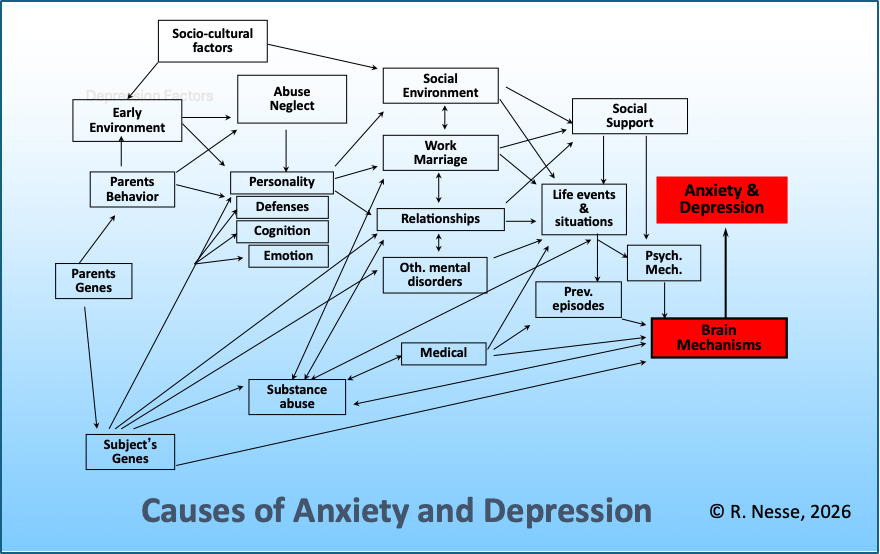
What gave rise to unfulfilled expectations? calls attention to psychiatry’s research paradigm. Adopting the model used in the rest of medicine was and is a sensible strategy. However, the version adopted in psychiatry has focused on reductionist searches for mechanisms and specific abnormalities, with little attention to the study of normal functions that guides research in the rest of medicine.5,6 Heart disease is understood in the context of deep knowledge about the functions of the heart in general and each of its valves and conduction pathways. There are bits and pieces about how mood can be useful, but no body of knowledge about function that grounds the study of mood and its disorders.
What is the function of depression? seems like a good question whose answers should provide an understanding of normal function like that used in the rest of medicine and good progress is being made in proposing plausible evolutionary hypotheses.7–11 However, depression is not an organ like the kidney or the heart with a single function. In its nonpathological form it serves many functions, many of which are also served by other emotions, making hypotheses about its function hard to assess. Nonpathological depression is like cough, fever, pain, and vomiting—defensive responses that give advantages when expressed in the appropriate situation, but that also cause terrible distress, have high costs, and are prone to dysregulation that causes diseases such as chronic pain and major depression. Attempts to find the function of depression are also complicated by use of the term to describe states ranging from ordinary low mood to melancholic depression. Framing questions about the universal capacity for low mood reduces these difficulties.
What is the function of low mood? encourages study of the benefits that shaped the adaptive response whose dysregulation can cause depression. While there is general agreement that sadness and low mood can be normal, there is little agreement about when and how. Like other protective responses, low mood is useful despite, and to some extent because of, its aversiveness. Pain is useful when tissue is being damaged. Cough clears foreign material from the respiratory system. Low mood does not have one function, it has many. The list below is adapted from one of my recent articles.12
Functions proposed for low mood and/or depression
Soliciting help (Lewis, Klerman, Hamburg)
Involuntary yielding after losing a status battle (Price, Sloman, Gilbert)
Sickness behavior (Hart, Raison)
Conservation of resources (Engel, Beck)
Extortion of resources (Hagen)
Social navigation (Watson and Andrews)
Disengagement from useless pursuits (Klinger, Brickman, Nesse)
Adjusting effort intensity and goals (Klinger, Nesse)
Withdrawal to solve a problem (Gut, Andrews and Thompson)
Motivating behaviors to gain group acceptance (Allen, Leary)Debates swirl about which function is most important. Every author argues for his or her favorite. Mine is that mood adjusts the object and intensity of effort depending on the propitiousness of the situation.13,14 When a small investment seems likely to result in large payoffs, high mood encourages intense efforts to take advantage of the opportunity. When efforts seem unlikely to payoff, low mood conserves energy and avoids risks. Even if globally correct, this function is so general it applies to hibernation as well as it does to depression. It also does not explain feelings of guilt, worthlessness, and hopelessness. The social functions of depression on the list offer far more specific explanations.
I have been deeply involved with these controversies, advocating, like others, for my favorite functions. However, in my enthusiasm for my favored functions, I ignored the conclusion from my 1990 article on evolutionary explanations of emotions: different emotions don’t correspond to different functions, they correspond to the different situations that shaped them.15 Those situations overlap, they pose overlapping adaptive challenges, and responses that are useful in one situation are useful in others. As a result, emotions have overlapping blurry boundaries and multiple functions that frustrate efforts to create crisp classifications and find specific functions.16
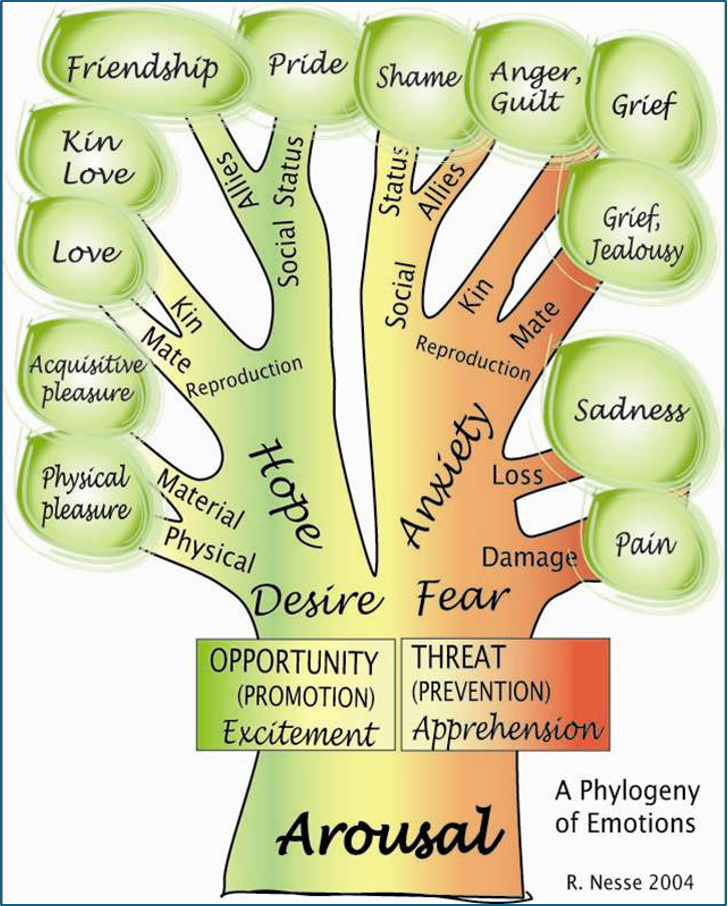
The core obstacle for emotion research is the pervasiveness of tacit creationism that views evolved systems as if they are products of design, without any mention of a supernatural designer.17,18 Designed systems have discrete parts with specific functions and simple connections. Evolved systems can have parts with blurry boundaries, multiple functions, and networked connections whose complexity and failure modes are different in kind from that in machines.19 Tacit creationism satisfies the human craving for simplicity at the cost of grossly distorting the nature of evolved systems. Even those of us using an evolutionary perspective are vulnerable.
What situations have shaped the capacity for low mood? is the question whose answers can provide the missing foundation for understanding the normal functions of mood variation. A major project is needed to discover what situations have been relevant and the responses they arouse. The list below is no substitute for needed research. Likewise, the four categories of situations in which low mood can be useful are only suggestions: lack of resources, temporary bad condition or environment, losses, and lack of progress towards a goal.
This perspective highlights the differences between sadness and low mood. Sadness is aroused by a loss; it assists in recovering or replacing what was lost or reorganizing life to continue without it.20,21 Low mood and depression, by contrast, are more often aroused when efforts to reach a goal are failing. They continue indefinitely until a new strategy or new goal is adopted. Inability to give up the pursuit of an unreachable goal escalates low mood into clinical depression, as recognized by Eric Klinger decades ago.22
Situations in which low mood may be useful
Deficiencies of resources that are essential for goal pursuit
Food, shelter, money
Attractiveness in mating competitions
Needing help that is not forthcoming from kin and friends
Social resources needed for status competition
Unpropitious environment or poor personal condition
Famine
Harsh seasons in which foraging efforts waste energy
Infection
Other health problems
Failing efforts
Failing efforts to make progress towards a goal
Difficult decisions about incompatible strategies
Social traps whose escape requires major risks or costs
Loss
Status, especially after loss of a competition.
Role or position in a group
Membership in a group
A mate
A friend or relative
Health or vigor
A life enterprise or strategy
This article emphasizes the utility of the capacity for low mood, but that should not distract from the many specific episodes of depression that are endogenous and useless. In about a third of my depressed patients, I could find no relevant event or situation likely to account for the symptoms. Primary causation from brain variations is likely in many such cases, but attention to possible relevant situations is essential to rule them out.
The need to accept the messy reality of emotions
How I wish there was some simple explanation for depression! We love science because it simplifies, but the reality of emotions is messy as well as complex. If low mood had just one or two functions or if it had been shaped by the challenges in just one or two situations, the next steps would be straightforward. However, natural selection just does what it does in new situations a species encounters, shaping overlapping special states from previous special states in conjunction with revised control systems that process cues associated with the new situation. Different situations give rise to somewhat different depression symptoms in patterns that seem adaptive.11,23–25 It would be wonderful if the resulting patterns were separate enough to be subtypes.26 However, the resulting syndromes are not different enough to be distinct subtypes, they are more like the ill-defined parts of a summer cloud.

Progress will come accepting the unsatisfying reality of the cloud-like structure of low mood states and their multiple functions and forging ahead with rigorous research nonetheless. A series of projects will be necessary to create a scientific understanding of normal mood functions.
Create an inventory the situations likely to have shaped capacities for low mood, using data and methods from behavioral ecology and studies of other animals.
Identify the adaptive challenges each situation poses.
Assess the costs and benefits of each aspect of low mood in each situation.
Discover the cues the control system uses to regulate mood.
Try to reverse engineer the algorithms used by the control system.
Confirm the differences in symptoms aroused by different situations.
Use phylogenomic methods to discover the systems low mood evolved from.
Study the effects of learning and drugs on control system parameters.
Integrate the findings with data on the adaptive, stochastic, and maladaptive origins of individual variations in mood baselines and regulation.
Finally, use this understanding of normal mood to assess the relative importance of different evolutionary explanations for why mood systems are vulnerable to failure.
These are not tasks for individual researchers or even small groups. Creating the needed understanding of how the adaptive challenges in a diverse set of situations shaped capacities for mood variation and its control systems will require substantial support for a decade of research by a group of scientists with expertise in psychiatry, psychology, emotions, neuroscience, evolutionary biology, behavioral ecology, epidemiology, mathematical modeling, and control systems. The cost would be substantial, but understanding the functions and regulation of normal low mood would offer the huge payoff of providing a foundation for understanding mood disorders.
References
1. Repple J, Chevance A, Fried E, et al. Key challenges in advancing research on depression phenotyping. Nat Ment Health. 2026;4(6):898-911. doi:10.1038/s44220-026-00629-1
2. Cosgrove L, Patterson EH, Bursztajn HJ. Industry influence on mental health research: depression as a case example. Front Med. 2024;10:1320304. doi:10.3389/fmed.2023.1320304
3. Abed R, Swanepoel A, O’Connell H. Evolutionary psychiatry and the activities of the relevant WPA Section. World Psychiatry. 2025;24(3):456-457. doi:10.1002/wps.21370
4. Kendler KS. Levels of explanation in psychiatric and substance use disorders: implications for the development of an etiologically based nosology. Mol Psychiatry. 2012;17(1):11-21. doi:10.1038/mp.2011.70
5. Kendler KS. Explanatory Models for Psychiatric Illness. Am J Psychiatry. 2008;165(6):695-702. doi:10.1176/appi.ajp.2008.07071061
6. Nesse RM, Stein DJ. Towards a genuinely medical model for psychiatric nosology. BMC Med. 2012;10(1):1. doi:10.1186/1741-7015-10-5
7. Hagen EH. Evolutionary theories of depression: a critical review. Can J Psychiatry. 2011;56(12):716-726.
8. Rantala MJ, Luoto S. Evolutionary Perspectives on Depression. In: Abed RT, St John-Smith P, eds. Evolutionary Psychiatry: Current Perspectives on Evolution and Mental Health. Cambridge University Press; 2022:117-133. Accessed February 14, 2022. https://www.cambridge.org/core/books/evolutionary-psychiatry/2A1862AA7A2D78F946A34475D98425EB
9. Forgas JP. The Evolutionary Functions of Sadness: The Cognitive and Social Benefits of Negative Affect. In: Al-Shawaf L, Shackelford TK, eds. The Oxford Handbook of Evolution and the Emotions. Oxford University Press; 2024:0. doi:10.1093/oxfordhb/9780197544754.013.29
10. Nettle D. Evolutionary origins of depression: a review and reformulation. J Affect Disord. 2004;81(2):91-102. doi:10.1016/j.jad.2003.08.009
11. Durisko Z, Mulsant BH, Andrews PW. An adaptationist perspective on the etiology of depression. J Affect Disord. 2015;172:315-323. doi:10.1016/j.jad.2014.09.032
12. Nesse RM. Evolutionary psychiatry: foundations, progress and challenges. World Psychiatry. 2023;22(2):177-202. doi:10.1002/wps.21072
13. Turner J. Bad Feelings, Best Explanations: In Defence of the Propitiousness Theory of the Low Mood System. Erkenntnis. Published online January 22, 2024. doi:10.1007/s10670-023-00773-5
14. Nesse RM. Is Depression an Adaptation? Arch Gen Psychiatry. 2000;57(1):14. doi:10.1001/archpsyc.57.1.14
15. Nesse RM. Evolutionary explanations of emotions. Hum Nat. 1990;1(3):261-289. doi:10.1007/BF02733986
16. Nesse RM, Ellsworth PC. Evolution, emotions, and emotional disorders. Am Psychol. 2009;64(2):129-139. doi:10.1037/a0013503
17. Stein DJ, Nesse RM. Tacit Creationism Encourages Oversimplified Views of Functions and Dysfunctions. Eur J Neurosci. 2025;61:e70028. doi:10.1111/ejn.70028
18. Nesse RM. Tacit Creationism in Emotions Research. Emot Res ISRE’s Sourceb Res Emot Affect. Published online June 2, 2020. http://emotionresearcher.com/tacit-creationism-in-emotion-research/
19. Nesse RM, Labov JB, Madhavan G. Explanations for failures in designed and evolved systems. Abbott D, ed. PNAS Nexus. 2025;4(4):pgaf086. doi:10.1093/pnasnexus/pgaf086
20. Huron D. The Science of Sadness: A New Understanding of Emotion. The MIT Press; 2024. doi:10.7551/mitpress/15262.001.0001
21. Loewenstein G. Opposite of Happiness: How Bad Feelings Make and Break Us. Harper; 2026.
22. Klinger E. Consequences of commitment to and disengagement from incentives. Psychol Rev. 1975;82(1):1-25. doi:10.1037/h0076171
23. Keller MC, Nesse RM. The evolutionary significance of depressive symptoms: Different adverse situations lead to different depressive symptom patterns. J Pers Soc Psychol. 2006;91(2):316-330. doi:10.1037/0022-3514.91.2.316
24. Maitino AA, Rosenfarb IF, Glaser DN, Keller MC. An evolutionary investigation of depressed mood: The relationship between daily stressors and patterns of depressive symptoms. J Behav Ther Exp Psychiatry. 2022;76:101749. doi:10.1016/j.jbtep.2022.101749
25. Keller MC, Neale MC, Kendler KS. Association of Different Adverse Life Events With Distinct Patterns of Depressive Symptoms. Am J Psychiatry. 2007;164(10):1521-1529. doi:10.1176/appi.ajp.2007.06091564
26. Rantala MJ, Luoto S. Depression: Evolution, Biology, and Treatments. Cambridge University Press; 2026.
Thank you very interesting
Out of curiosity, do you think that dogs, elephants and apes (to name a few) also evolved a susceptibility for depression and, if so, do you think it’s for different reasons than humans?